
As mid-market companies increasingly explore offshoring, it's crucial to approach implementation with a well-thought-out strategy.
The landscape has evolved, making it possible for even smaller companies to build remote offshore teams starting with three or four people — and to access a wider range of skillsets than ever before. As companies launch a plan to build a global team, there's a set of strategic questions to answer before moving to implementation.
What Work Should Be Moved?
An offshore strategy should be part of a comprehensive "work strategy." Before deciding to offshore any task, companies should first consider whether it can be eliminated or reduced — is the work delivering an outcome or product actually used by another team member, customer, or supplier? If not, that work needs to be eliminated.
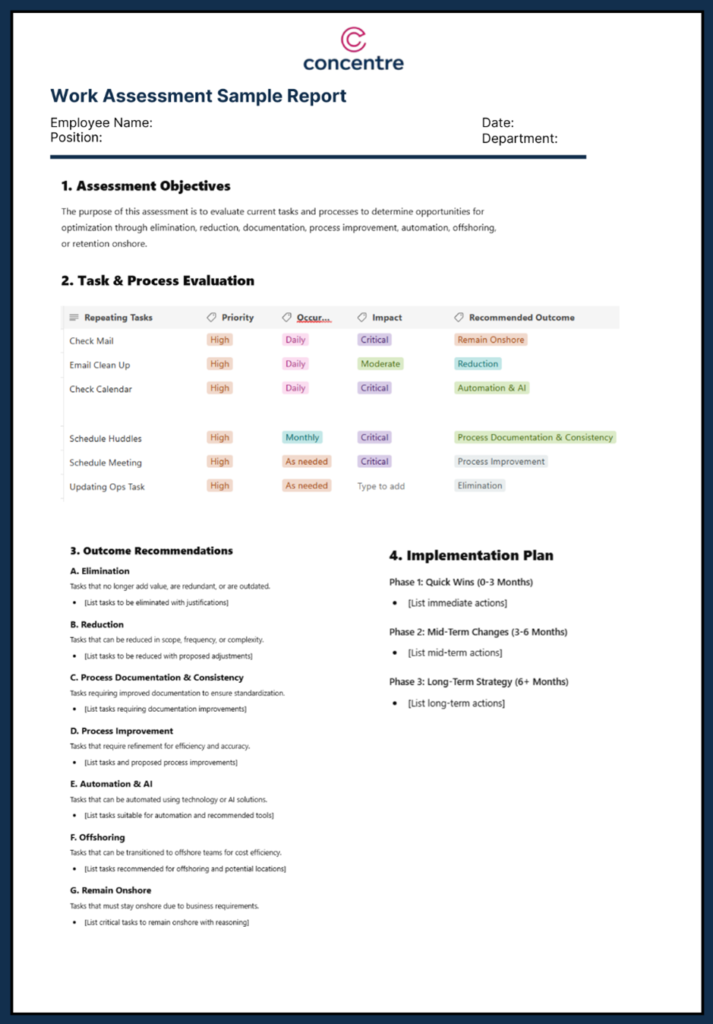
Tools like a Process & Work assessment can give an objective view of where the opportunities exist and the likely challenges in changing how that work is done. This approach ensures offshoring efforts focus on higher-complexity tasks that truly require human skill and judgment — and helps clearly define the roles and skillsets the offshore team needs.
How Difficult Will It Be to Move the Work?
Several factors influence the ease and success of implementation:
- Work Repeatability — Companies with clear, repeatable (and consistently repeated) processes are often better suited for offshoring, even without documented SOPs.
- Strength of SOPs — Robust standard operating procedures make it easier to train and integrate offshore team members.
- Data Quality — Good data management practices are crucial for effective collaboration and communication.
- Team Structure — A clear structure for how work moves through the organization is far easier than a team supporting multiple functions or processes.
- Training — The complexity of the tasks to be moved, and the team's capacity to deliver effective training.
It's worth noting that while companies nearing an exit can still benefit from offshoring, implementing a comprehensive offshore strategy often requires a multi-year approach for optimal results.
Time Zone Management: Challenge & Opportunity
One of the primary considerations is managing work across time zones — particularly crucial for time-sensitive tasks like month-end closes or tax filings. But what initially appears as a challenge can also be a significant advantage.
Companies can leverage the time difference to create a 24-hour work cycle, improving customer service and operational efficiency. Work started by an onshore team can be continued offshore, ensuring faster turnaround. The key is to strategically decide which tasks suit synchronous (real-time) collaboration and which can be handled asynchronously and continuously.
Build vs. Buy: A Critical Decision
One of the fundamental strategic decisions is whether to build an in-house offshore team or partner with an external provider. This often depends on the company's time horizon (especially important for PE-backed companies considering an exit), the specific roles being recruited, and the planned team size.
Building in-house offers more control and can be more cost-effective long term, but requires significant upfront investment in recruitment, training, and management. Partnering with a provider offers quicker setup and access to established processes, but may come with less control and potentially higher costs over time.
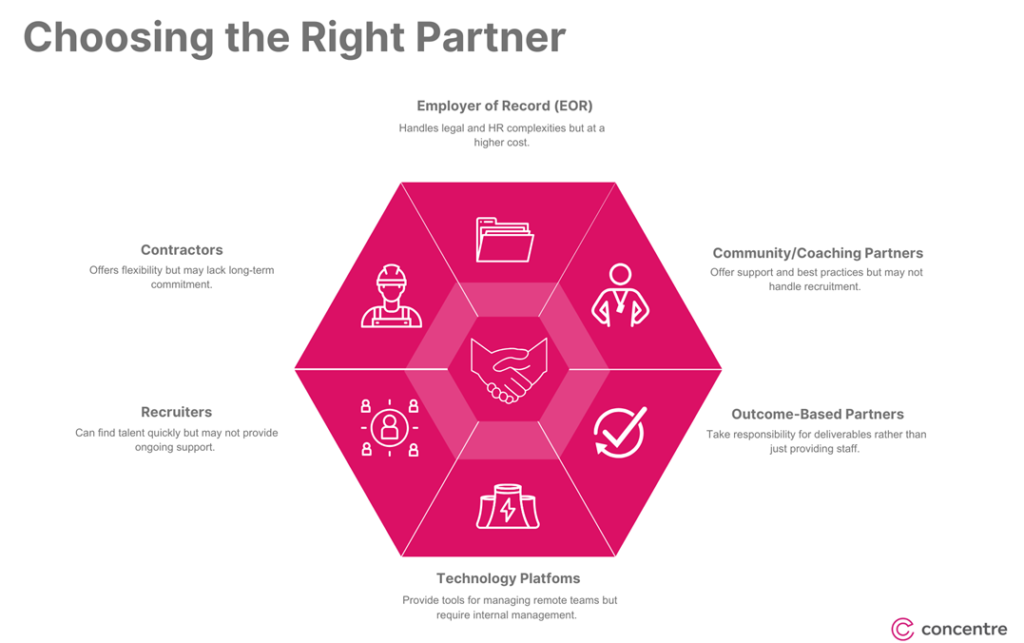
Choosing the Right Partner
If the decision is to "buy," companies have several options:
- Contractors — Offer flexibility but may lack long-term commitment.
- Employer of Record (EOR) — Handles legal and HR complexities, at a higher cost.
- Recruiters — Can find talent quickly but may not provide ongoing support.
- Technology Platforms — Provide tools for managing remote teams but require internal management.
- Community / Coaching Partners — Offer support and best practices but may not handle recruitment.
- Outcome-Based Partners — Take responsibility for deliverables rather than just providing staff.
Each option has its pros and cons, and the choice depends on the company's specific needs, resources, and long-term strategy.
Location & Culture Considerations
Choosing the right offshore location involves balancing several factors:
- Access to talent and specific skill types
- Quality of education and training
- Current and projected labor costs
- Cultural norms and work ethics
- Time zone alignment
- Legal and regulatory environment
Some traditional offshoring destinations have seen significant cost increases. Companies need to look beyond current costs and consider long-term trends and cultural fit.
Client Positioning & Pricing
Implementing an offshore strategy may impact how products and services are structured, packaged, or priced. Companies need to decide whether offshore roles will be "unseen" from the client perspective, or part of the value proposition.
For some businesses, offshoring enables round-the-clock service or quicker turnaround — a selling point. For others, it allows more competitive pricing that drives market-share gains. The key is to align the offshore strategy with the overall value proposition to clients.
Compliance & Regulatory Issues
Companies need to be aware of compliance issues in different countries, particularly regarding employee payments and tax responsibilities. Some countries have strict regulations about how employees must be paid and who is responsible for state and local taxes. Working with local experts or using an Employer of Record can help navigate these complexities.
Communication Strategy
When implementing an offshore strategy, clear communication with existing team members is crucial. Outline the benefits for current employees — skill development, leadership roles managing offshore teams, or focusing on higher-value work. This is often easier in rapidly growing companies, where offshoring supports expansion rather than replacement.
The pandemic accelerated the adoption of remote work, making offshoring more acceptable to both employees and clients. By addressing these strategic issues thoughtfully, mid-market companies can leverage global talent to drive growth, increase efficiency, and strengthen their competitive position.

