
The success of offshore teams hinges on effective operational implementation. Strategy doesn't staff a call center queue; operations do.
If you are building an offshore team, the dividend only shows up when day-to-day work runs effectively — success is clear to the integrated team, handoffs are smooth, data is secure, and customers are unfazed.
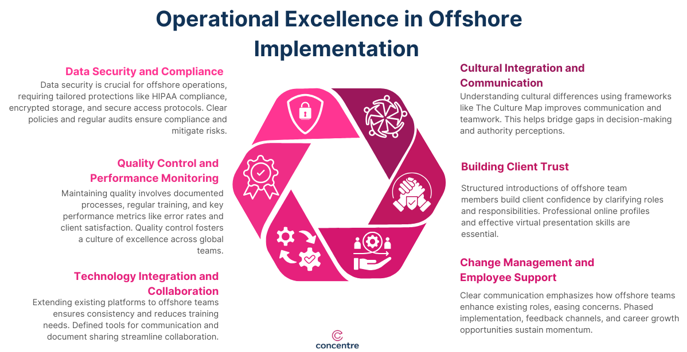
Mid-market companies implementing offshore teams must address several critical operational areas to ensure success. These are the six disciplines that are the difference between successful and failing global teams:
- Quality Control and Performance Monitoring
- Technology Integration & Collaboration
- Data Security and Compliance
- Cultural Integration and Communication
- Building Client Trust
- Change Management and Employee Support
01Quality Control & Performance Monitoring
Maintaining consistent quality across global teams requires a comprehensive approach to training and quality control. Successful companies establish clear quality standards through detailed process documentation and regular training programs, with specific checkpoints in their workflows where quality is assessed and verified.
Performance monitoring should focus on meaningful metrics that drive improvement. While these vary by industry, key indicators include throughput, error rates, turnaround time, and client satisfaction scores. Quality control isn't just about catching errors — it's about bringing clarity to what's expected and creating a culture of excellence that spans geographical boundaries.
02Technology Integration & Collaboration
Technology infrastructure must support seamless collaboration while maintaining security. Rather than implementing new systems, companies often find success by extending their existing platforms to offshore teams — reducing training requirements and ensuring consistency across locations.
Clear guidelines should define which tools are used for specific purposes — which platform is used for daily communication versus document sharing. This clarity prevents confusion and ensures efficient collaboration.
03Data Security & Compliance
Data security stands as a paramount concern when implementing offshore operations. Different types of sensitive information require varying levels of protection: patient health information demands strict HIPAA compliance, encrypted storage, and restricted access; financial records require secure transmission and multi-factor authentication; intellectual property needs watermarking and comprehensive access logging.
Beyond basic measures, companies must establish clear policies around data ownership and access control — defining who can access specific data types, how data is transmitted and stored, and how outputs are managed. Regular security audits ensure compliance and identify vulnerabilities before they become problems.
04Cultural Integration & Communication
Cultural differences can significantly impact team effectiveness. One common challenge is different comfort levels with asking questions or pushing back on established processes — some cultures may hesitate to ask for clarification or suggest improvements, even when they see better approaches.
Drawing from "The Culture Map" framework helps teams understand and bridge these differences. Understanding varying approaches to communication, decision-making, and authority prevents misunderstandings and builds stronger teams over time. For example, rotate who speaks first when debriefing or brainstorming, to reduce deference bias.
05Building Client Trust
Introducing offshore team members to clients requires careful planning and execution. Team members should maintain professional online profiles and understand how to present themselves effectively in virtual environments. A structured introduction process helps clients understand roles and responsibilities while building confidence in the expanded team.
This is one of the most important steps toward delivering an experience where employees are trusted and clients get the full benefit of the global team being built.
06Change Management & Employee Support
Successful implementation requires active support from existing team members. Clear communication about how offshore teams will enhance rather than replace current roles helps allay concerns. Highlighting opportunities for career growth — such as developing leadership skills by managing offshore teams — builds enthusiasm for the change.
Companies should establish regular feedback channels and celebrate successes to maintain momentum. A phased implementation approach allows organizations to learn and adjust as they grow their offshore capabilities.
Remote Done Right + Guardrails
One way to look at this: building a global team is just remote work with higher stakes. The same operating disciplines apply — distance and culture simply raise the bar on ensuring clarity, security, and trust. The same habits that make remote teams hum unlock offshore value:
Clear work definitions. Visible workflows. A steady review cadence. With that approach, "offshore" stops being a gamble and starts looking like a competitive advantage.
To get going, pick one team or function you already run. Apply the global-team guardrails for sixty days, then review to determine if the team is ready to scale offshore with confidence.

